
 Join more than 45,000 Inkarnators on our Discord server!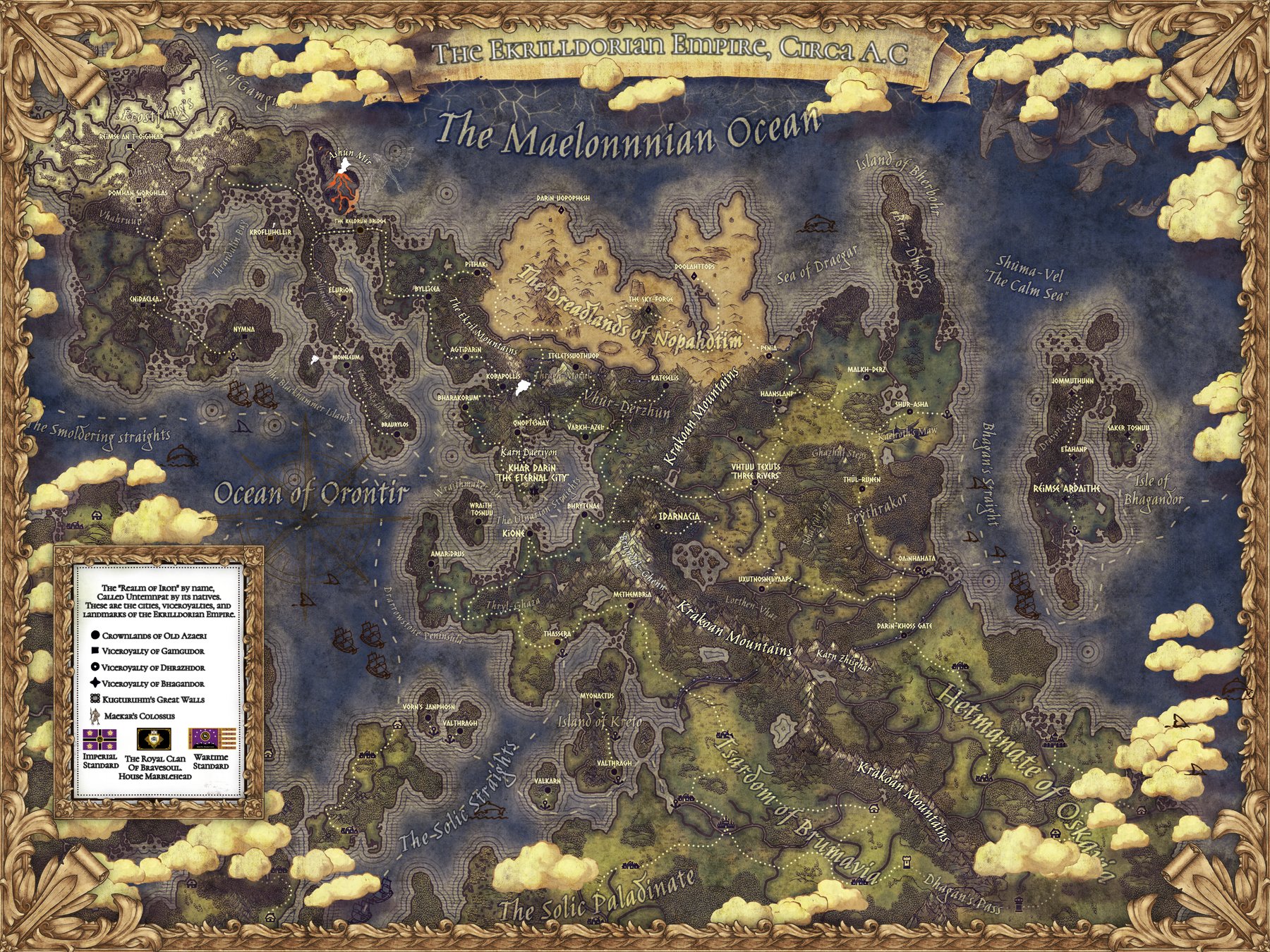
The realm of Untemnpat, the realm of the sons of Boic. Nustled between the Ekril and Krakoan mountains. This ancient civilization continues to stand tall against its threats both domestic and external. The Fyutennme "forge folk" call this rugged landscape of rolling hills, grass plains, and towering mountains their home. This map gives information for their cities, the names they have for forests and oceans, and most importantly their mountains.
Long live the Eternal Empire, Long live the King-Emperor, and Glory onto Oron's children.
Lore:
The age of creation:
The creation of the dwarves and the world at large. It was when the primordial gods created it in their image. The main gods mentioned are Oron, Seren, Kaeldrath, Maelon, Shigaur, and Cynthia. Oron made the planet itself over the course of five centuries in dwarven mythology. He carved the mountains, the coasts of the continents, and bound the heavens to the earth. All for the sole purpose of his grand vision, bringing life to their world. He carved dwarves from solid marble, giants from granite, and created a holy host of golems out of solid stone. Seren is believed to have made the first forests, elves, and the animals that would inhabit their world. Kaeldrath, the ever-cynical sibling of Seren, created the dark elves, orcs, beastfolk, and dark underdark for his drows. Maelon took to the seas and created the fish, whales, etc., including mer-people. Maelon is also believed to be the god of weather. Cynthia, Oron's favorite sibling, is said to have sacrificed herself in the first age when “Azhal” (The forsaken sibling), a dark demon conjured by desires, greed, and general chaos, took form and attempted to overrun their world. She is believed to have made men, halflings, and gnomes. She gave her life and took the place of the sun when Azhal stole it from the sky and corrupted it to serve his whims. After her death, later human civilizations who worshipped the sun would call her by the name “Solaris”. The main focus of these gods is going to be Oron. Starting at the date (Circa: D.C) “Dawn of creation,” in the year (1 D.C)
To defeat his siblings Azhal took to the sky and claimed the sun as his own. Drowning the realms in eternal darkness. In her wisdom and virtue Cynthia ascended to the heavens, sacrificing her mortal form to take the place of the sun. In his grief and vigor, Oron struck down his brother into the nine hells leaving a chasm so deep no mortal could see its end. After which Oron and his siblings once again ascended to the heavens leaving their respective races behind. But for the dwarves, the war came at a cost. Uruktharam's hearths had gone cold, there was no purpose for them to remain in their ancient home. So then did the nine tribes migrate across the globe to claim their own promised lands. This marks the beginning of the Age of migration and the end of the mythical period where gods walked among mortals. With imperial dating systems marking this period as A.E. - After exodus, and the years before as B.E.
While the other 9 clans ventured across the seas, over the mountains, across land bridges, and ventured out into the unknown. The clan we’re focusing on is the Azaerian clan and their descendants. A people of slightly slender figure, then most dwarves, with red fiery hair as if they were the essence of fire itself. Stout and vigorous and long-lived, with lifespans mostly between 900 and 1,200 years. Considered to be the oldest and divine of Orons' dwarven creations. They ventured down across the foothills of “The fallen star,” where Azhal was struck down by Oron in their battle beneath the stars. Blackening the mountains and landscape as he was banished into the deep. It is this land that the Azaerians named “The blackened hammer,” as the mountains still bear clear signs of Oron's wrath where his hammer struck the earth. Yet still they ventured on, arriving at the mightiest mountain they had ever seen. A range connected by 2 of the world's veins. The Ekrilldorian and Krakoan mountains, then known as the Ekril and Zhantian ranges. At the center of this vast range was the mountain of Minthril. Deciding to settle within it and the surrounding landscape. The Azaerians blessed their newfound home with the name “Oroniye”. In honor of their god in the year 308 (A.E).
Over the centuries, they formed the first true civilization on their continent of “Aenevitam”. Stemming from the root forms of their language, “Aene” means either eternal, unyielding, divine, or everlasting. As in their language, “Aen” (Sun) with “En” (Breath) can be interpreted as meaning “The breath that endures”. While “Vitam” can mean life, spirit, or being. It is tightly related to the word “Vitas”, which means life, and “Vitamen” - living one. It is one of the oldest epithets of Oron. So when fully translated, Aenevitam means “The everliving land” in old Azaerian, more formally known as “The land to which life itself was given eternal breath”. They were the ones who wrote the Book of the Nine Flames in the year (Circa 501 A.E) by a council of thanes. The oldest religious scripture of the cult of Oron. Where, when, oron forged the earth from Maemir's bones, breathing life onto the continent of Aenevitam and his seat of Uruktharam. This religious scripture is what has instilled their belief that they’re the chosen of Oron. Destined to claim the earth as their eternal mandate. From then on, after they wrote the scripture. The Azaerians would collectively call themselves “Darai-Vitamen,” translating to “Children of the living stone”.
The Age of the Metal (Circa 501 - 2502 A.E):
Over the next two millennia, the Azaerians developed into several tribal confederacies. Composed of rivaling houses, thanes, petty lords, and councils. Feuding over resources around the mountains. To the west, where the “Bhaskandur” clans. Who preferred the soft rolling foothills and flood valleys. Making their riches and advancements along the riverbeds. To the east, where the “Draemoi” prefer the harsh Zhantian mountains to the surrounding lowlands. Due to ever-persistent raids from not just their fellow dwarves. But from orcs, humans, and other mystical beasts native to the region. In the Midlands, where the “Kharni” styled themselves as the holiest of the clans. Living within Mount Oroniye itself. The last of the mightiest notable clans was the “Mikhillians,” who chose to establish their footholds across the southern coasts and dark caves hallowed out by erosion. These differing groups continued their rivalries and battles with each other for century after century, age after age. The dominance of either clan is achieved through technological advancements or ornate magical abilities. With the Kharni mastering the runes of metalurgy, they used these abilities to create the first bronze weaponry. Ushering in this world's Bronze Age in blood and conquest. As this knowledge spread, all the differing groups began forming their own city-states, holdfasts, and undercities. Carving out their own portion of the world.
The establishment of The Iron Confederacy “Ekril-Darûzharn”(Circa) 2502 - 3286 A.E):
During the following millennia and centuries, their societies continued to entrench themselves and become more interconnected. With growing threats from external factors of differing peoples and beasts. The clans chose to join together in a ceremonial confederation ruled by the “Kharnath” to wage war between them and rally the differing clans against threats. The official title of “Kharnath” came about through the Kharni clan. This title roughly translates from Old Azaerian into High King. These high kings would come and go at a time often varying between the clans. Tied together by family marriages, trade pacts, blood oaths, or simple treaties. Their city-states and wider territories would often pay tribute to said High Kings through a compact known as “The Highhall Assembly”. Composed of Thane-lords who were rulers of major holds and regions. Forge-lords who represented city guilds and magical groups such as the metalsmiths, geomancers, and rune-scribes. Then lastly, the stone-speakers who represented the ancestor cults and kept the deep runes. This assembly would gather during times of crisis, disaster, or to discuss matters of inheritance. The assembly itself more often than not collapsed into open infighting, leading to extended periods of the city-states waging war against each other. It was the place that could declare and unmake any High King. With several civil wars fought between brothers and cousins over who could hold the title. All the while, despite the internal and external conflicts, the Kharni clan from their seat of Oroniye continued to expand their stronghold. Raising estates and terraces along their mountain, contracting engineers and masons to build aqueducts and other public works, establishing official road networks among local trails further interconnecting the Azaerian people, Simplifying their holy scriptures and developing proper dating systems, pressuring the systems of tribal family clans to conform to their standards of efficiencyand bureucracy, and spending the following centuries absorbing lesser clans and realms under their hegemony over the next 700 years. In the year Circa 3986 A.E. the chieftan of the clan, the elderly and stubborn Thane Lothar Fronfrei, married off his son Darindur to the eldest daughter of the Draemoi clan to solidify a mere trade treaty.
The unification wars, and Darindur the city builder (Circa)3986 - 4923 A.E)
Laying the groundwork for his son's future wars of unification. For well over five centuries, Darindur did wage war on his brethren. Spilling the blood of every Azaerian clan in his efforts to unify their people. It was he who broke apart the old tribal clan structure and re-organized them around his city of Kharnathrangul. It is there, in those halls of clay and ancient scripture. He did make his capital of a new Azaerian Kingdom, one befitting the lifestyle of the sons of Oron. But in his pursuit for greatness he betrayed the holy texts forbidding greed, vanity, and other vile sins. With this tenant of the divine broken, Darindur indirectly conjured the Daemon prince Kaelroth'mal into the mortal plane. Who went on to slay Darindur in the battle of the seven saints. Subjugating the dwarves under his devilish dominion.
The Demon Prince of Azhgal and the rise of Boic Bravesoul(4923–4931 A.E.)
The mountain kingdom of Azaeri in 4923 A.E.,From the screaming pits of the Azhal's new rift beneath Kharnathrangul, in the under deep beneath Mount Oroiniye, Kaeroth’Mal, the Demon Prince of Smoke and Fangs. He had corrupted three of the Nine Deepholds, enthralled half a dozen Stonecaster circles, and birthed an army of ashkin and soul-ghasts. The dwarves called it the Dark Siege of Azaeri. Under this shadow, trade with the surface collapsed, and dwarven citadels sealed themselves in. Till a lowly smith named Boic refused to bend. In the winter of 4925, he allied with the geomantic Brotherhood of Azrun-Khaal and raised the First Flame Host—a sacred army of dwarves whose weapons were sanctified in the sunforges and whose armor bore the ancient runes of the Dayfather. The campaign to retake the Deepholds lasted six years and cost of thousands of lives. In the final battle beneath the palace of Zhal Norr , Boic personally slew Kaeroth’Mal in single combat, wielding the ancestral greathammer Durandhûr. Forged with a diamond head capable enough to crack the skull of the foul lord. The tale is still sung by Deepcantors: “Three times was Boic burned, yet did he rise" "Till demon spine lay shattered ‘neath mountain skies.” . With Kaeroth’Mal’s death, the Rift collapsed, sealing away the last remnants of his hell-spawn, and the forges of Azaeri were lit once more. Thus began the reign of clan Bravesoul, and the second rise of the Kingdom of Azaeri.
The Rebuilder King (4932–4956 A.E.)
Boic was crowned not just as a war king but as a reunifier. He understood that peace required more than victory, it needed vision. Under his rule, the dwarves rebuilt the lost Deepholds and reconnected with surface outposts long abandoned. He established the Stone Concord, a pact of mutual defense and trade between the dwarven realms of Azaeri, Krakoa, Haldrûn, and the Stonefleet of Kur-Vanost. Boic was a patron of learning and commissioned the Chronicle of the Nine Anvils, the first unified dwarven historical text in over three hundred years. Trade routes were reopened, ancient roads reforged, and three new cities were founded in the lower valleys—Grunfel, Duraskar, and Harn-Vael. Marking the start of dwarven re-expansion. Perhaps his greatest peacetime achievement was the colonization of the Black Hammer Peninsula, a mineral-rich headland beyond the western fjords, long feared for its black storms and cursed ruins. Boic established Braurylos, the Hammer Port, as a central bastion of dwarven naval power and founded the Deepward Guild, which would become the backbone of Ekrilldorian economic might in the centuries to come. By 4950 A.E., dwarven influence stretched farther than it had since the Age of Myth, and whispers began to circulate in the low courts and high holds alike: that Boic’s rule was not merely that of a king, it was imperial. But Boic would never claim the title of Emperor. In his later years, Boic grew reflective. He spent more and more time in the deep halls of Akhmar-Zûn, where he commissioned murals, runic poems, and memory vaults in Kharnathrangul. It was said he feared not death, but forgetting. To his son Maekar, he said:
“Stone may endure, but if no hand recalls why it was shaped, even the mountains forget.”
Maekar, already a seasoned general by then, grew restless under his father’s cautious stewardship. Where Boic saw preservation, Maekar saw an opportunity, power yet unconquered. In 4962 A.E., Boic passed peacefully during the Festival of the First Forge, surrounded by kin and runesmiths. He was interred in the Hall of Echoes, beneath the Iron Veil Range, beneath a statue that bore no crown, only a hammer. The mourning lasted seven days. On the eighth, Maekar shattered the ancient septum wall of the Stone Concord Hall with Durandhûr and declared:
“My father ruled a kingdom. I will rule a world.”
The braziers of Azaeri burned low on the night Maekar summoned his kin to the Halls of Zhal Norr the same chamber where their father, King Boic Bravesoul, had been laid to rest only days before. The air was heavy with the scent of oil and iron. Not mourning, but decisiveness. The eldest son of Boic, Maekar, stood before the Throne of the Flame, not yet crowned, yet draped in crimson and onyx, his vermillion beard braided in the Azaerian style. His gaze was sharp and unyielding. To his right stood the Royal Justiciar. To his left, the Writ of Succession, sealed in molten wax and bearing the sigil of the Eternal Flame. His three brothers of Tharnan, Durek, and Belgarin had ridden from across the realm to witness the coronation. They would not leave as princes. In a chamber locked to all but kin and fire, Maekar spoke first:
“Father built a kingdom. I shall build an empire. But only one flame can burn in the hearth of Oron. If you seek to stoke your own, then let us settle it by steel—and see how many sons Boic truly has by sunset.”
Tharnan, the eldest after Maekar, was silent. Durek muttered dissent. Belgarin laughed, but the mirth did not reach his eyes. Ultimately, they chose peace over war bound by blood, legacy, and Maekar’s overwhelming will. Each brother knelt and placed their hand upon the Flame Sigil. Before the embers, they renounced their claim.
“We surrender the Crown,” Tharnan said, voice trembling, “and take up the Hammer. Let the Empire rise.”
The Founding of the Tri-Cities
Maekar, shrewd as he was ruthless, gave each of his brothers a charge, not exile. He knew an empire could not be built by sword alone—it would need cities, ports, and fortresses.
• Tharnan Bravesoul
Founded Khar Darin at the mouth of the Ulnarion Strait, a vital chokepoint of southern trade. Designed with high granite walls and inner terraces, it would become the naval heart of the future Empire.
“A city for Limestone and silver, where ships obey dwarves and the sea bends to our will.”
• Durek Bravesoul
Built Bharakorum on the southern coast of the Oronian Sea, a crossroads of merchant fleets and pilgrims. With wide avenues and radiant temples, it became the Empire’s spiritual and cultural capital.
“Let the gods find a voice here, and the world shall listen.”
• Belgarin Bravesoul
Ventured into the Krakoan northern foothills, establishing Kione, a mountain bastion laced with mines and fortresses. It served as the southern defense against barbarian incursions and frontier threats.
With his brothers out of the way in a ceremony beneath the mountain’s heart, Maekar was crowned King of Azaeri and declared himself Emperor of Ekrilldor, uniting the dwarven holdings, colonies, and protectorates under a single banner—the Black Crown. He reforged his father's alliances into vassalage, demanded oath signs from all Thanes, and proclaimed that no dwarf would ever again kneel to surface-born threats. The age of defense had ended. An age of dominion had begun.
Maekar's Campaigns of Subjugation (Circa) 4966–5787 A.E.)
Following his coronation, Maekar initiated a series of unification-by-force campaigns to bring the outer lands under dwarven dominion. The Ekrilldorian military, born from the crucible of Boic Bravesoul’s reign and hardened under Maekar, was a professionalized, centralized force. It was divided into Legions, each functioning as a semi-autonomous war Golems, with a strict hierarchy and rotating logistics. He dawned his host in Thraenite armor, weaponry, and tools. Making it the strongest standing army in a world still using bronze. From 4966 - 5787 A.E. Maekar made the world bleed from the northern plains to the southern deserts, from the lands that would become the northern human kingdoms to Kayvaryurt in the southwest, from defiant Dhrazhdor down the krakoans spine to Aramia. Cementing into place a warrior dynasty and empire that would hold dominion over the entire continent for nearly eight millennia.
Fragment from the “Testament of Marrik”, rebel scribe of Kayvaryurt
Circa 4972 A.E., Year Two of Maekar’s Occupation
They came with their braziers and banners and their thunder-boots on the stones we carved. The dwarves of Ekrilldor, broad in chest, thin in pity. I watched them come down from the mountain passes like stone tumbling toward fire, and I knew then: the empire had come for us not with law, but with forging hammers. They didn’t ask for oaths. They demanded names. Not just ours, but our fathers’, our gods, our rivers, even our stars. They burned our scrolls. They scratched runes over our tombstones. The Flamefather’s priests took our calendar and named it "corrupt." We are told now we were “delivered.” My cousin, Rohen, spat at a Flamewarden. He died with coals down his throat. My daughter, Saela, whispered a prayer to our Moon-Mother. They carved her lips shut and hung her from the Curtain Gate, still breathing. That night I buried her beneath a fig tree while they sang their victory hymns from the temple they had painted over in black gold. I was not a soldier then. I am now. We struck back, in the hills outside Altiscanium. A dozen of us—sculptors, weavers, scribes—became butchers. We slit a legate’s throat and fed his bones to his bronze-helmed mule. We dragged one of their generals into the river and drowned him beneath a tide of oil. For three nights we burned the Flame shrines. We thought Oron would hear and weep. He didn’t. On the fourth, the hammer came. Their reply was fire. Not red, but white. I watched children burn without sound, and knew they had learned silence from their mothers. The markets of our ancestors were lined with spikes and crowned with the heads of rebels. The dwarves called it “justice.” Before they took me, I carved this.
I want someone to know: that we were not savages.
We worshipped different stars. That is all.
We drank from our own wells. That is all.
We wanted to remember who we were. That is all.
And for that… they took everything.
If you find this: let them call me a traitor.
But remember this—
The Flame burns cleanest when it devours the truth.
—Marrik, son of Sarven, last free scribe of Kayvaryurt
The Aramian Campeign
The Ashes of Krakoa. The fire that lit the forge of vengeance began in Krakoa. In the year 4978 A.E. (After the Exodus), the 13th Krakoan Legion of the Ekrilldorian Empire a dwarven host of 10,000 strong marched into Northern Aramia under orders to secure trade routes and pacify hostile frontier clans. Instead, they vanished in Tal al-Gharb. Only a single scout returned to Highhold, bloodied and broken, carrying a banner torn in half and a tongue removed. The Krakoan Legion had been ambushed and annihilated by a confederation of Aramian warlords in what became known as the Massacre of Veilreach.
The loss was more than military. Krakoa had been Maekar’s personal retreat, the jewel-mine province of the eastern reaches, and the 13th Legion had been filled with kin, friends, and mentors. The King-Emperor wept not before his court but on the Day of Black Iron, he emerged from the Temple of the Deep Forge clad in blackened steel, crowned with obsidian, and bearing the ancestral war-axe Skandral, whose edge was said to sever soul from flesh. He swore the Oath of Rending: that not a single stone of Northern Aramia would remain unblooded, and that its cities would kneel to the Black Crown or burn. Thus began the March of Iron (4980–4983 A.E.). With the full might of the Ekrilldorian Empire at his command, Maekar raised the greatest host in dwarven history: 80,000 soldiers, 3,000 war machines, and 400 Stonecasters rune-marked geomancers who could shatter cliffs and shape fortresses from the bones of the earth. He began with the border cities Agashtul, Shufaga, and Fellhollow all fell within a single season. The resistance was brave but piecemeal. Maekar was ruthless. After each conquest, the garrisons were crucified on iron trees, and their commanders were burned alive in their halls. Survivors were shackled and forced to walk south carrying the severed heads of their lords. By 4982, Maekar’s host reached the Red Basin, where the tribal armies of Northern Aramia, under Warlord Haraj the Silver-Eyed, stood in united defiance. In the Battle of Varkuun, the Aramians outnumbered Maekar two to one—but the dwarves had Stonecasters, Dragonfire ballistae, and fury. The basin ran red for three days. Haraj was captured, skinned alive, and his hide turned into a war banner that Maekar would ride under for the rest of the campaign. Notably, Maekar took the plucked feathers of slain phoenixes as war trophies.
VIII. Fire Upon the Highlands (4983–4987 A.E.)
What followed was not conquest it was a purge. The dwarven host split into four "Mourn Companies," each commanded by a Thane-Warden sworn directly to Maekar. Their sole command:
"Leave no light standing."
Villages were torched. Wells were poisoned. Crops were salted. Stonecasters collapsed mountain passes to trap fleeing clans. In the winter of 4985, Maekar oversaw the Scouring of Tolvahr, where 30,000 civilians were sealed inside their city and set alight with brimstone runes. By 4986, only the great cities of Northern Aramia remained: Shaam, Kezhan, and Myrrdal. Kezhan fell to treachery—a priest of the Sun Court opened its gates for gold and a seat in Maekar’s new vassal court. Myrrdal held for thirteen months before falling in the Siege of Chains, where dwarves dragged the city walls down with rune-enslaved mountain wyrms. The survivors of both cities were marched north to Shaam to witness what came next.
The Fall of Shaam (Circa) 4987 A.E.)
This was Maekars magnum opus, the greatest accomplishment of his campaign. Shaam was the heart of Northern Aramia, a metropolis of crystal domes, sky bridges, and towering spires of sunstone. It was said the city had never fallen in 2,000 years. Maekar laid siege with every engine and spell in his arsenal. The dwarves tunneled beneath the walls, dropped meteoric hammers from catapults, and rained black from enchanted braziers. For five months, Shaam resisted. Then, on the morning of the Winter Solstice, Maekar unveiled his final horror, the Doomrider, a siege beast wrought of dead Stonecasters fused into a walking forge of death. It breached Shaam’s Crystal Gate in a single blow. What followed became a legend. Maekar led the assault personally, cleaving through defenders with Skandral, his obsidian crown glowing with rune fire. The Sack of Shaam lasted three days. Over 100,000 died. The Tower of the Sun was pulled down stone by stone and rebuilt into a dwarven ziggurat called Mournspire, atop which Maekar crowned himself Highlord of Ash and Flame. He poured molten gold into the mouths of the surviving nobles and ground the Sun Court’s relics into powder.
Emperor Maekar Bravesoul, having pacified all of Aenevitam turned his mind from conquest to perpetuity. He spent the rest of his reign ordering he construction of golems, assimilating conquered lands, and feasting away on the fruits of his labor. A new age made by his hands, and bathed in the blood of countless souls.
The Long Reign of Iron (5787 A.E. – 13,787 A.E.)
After Maekar’s death in 5788 A.E. The Black Crown passed to his son Gringir the Iron-Fisted, a ruler of sharp cunning and cold cruelty. He bore none of Boic's humility, nor Maekar's fire only a pitiless drive to expand the dominion his father forged. Under Gringir and his heirs, the Ekrilldorian Empire entered its Millennial Zenith, a golden age of technological mastery, magical command, and military dominance. To rule over his now vast domain, Gringir established an Imperial senate and guild council. To rule through the crown and manage its lesser affairs as a golden age was assured in. Through golden times of 6,000 A.E. – 13,787 expansionism caused strain on the empire and the likelihood of an Army revolt due to constant campaigns. Duran the lawgiver son of Gringir declared an end to their conquests. What followed in the coming millennia is remembered as the "Golden Times". With abundance in resources, whether it be food, raw minerals, or labor. The innovations in art, science, engineering, and warfare became widespread. Decisive measurements made by sages developed the first stages of Algebra and calculus. Masons and architects went above and beyond in using their calculations to experiment in their works. Helped by their aptness for reinforcing structures for harsh subterranean conditions. They were the first to develop domes, advanced sewage, Rune smithing, etc. With all of their collective knowledge at home and abroad being collected in Kharnathrangul. While in the background at the mouth of the copper sea. The once irrelevant fishing town of Nedrak is now Khar Darin. Became a thriving merchant city, imposing trade taxes, tariffs, and mandatory tolls for crossing the straights, or simply crossing their portion of the mountains. Enriching itself and slowly but surely becoming the 3rd largest city in the empire, Second only to far off Bharakorum, a now bustling city. The descendants of Human "Manthri" who were enslaved and brought to the city. Had over the millennia slowly but surely revolted, argued, or bought their way into mostly equal standing. A subculture developed from these people. Now considering themselves Ekrilldorian. So continued the reign of the First Ekrilldorian Empire. From the isle of Gamgudor to the Aramian desert, even stretching across to the continent of Katarini and onwards. It withstood countless plagues, natural disasters, revolts, and invasions. As millennia after millennia passed.
Age of Decay (10,600 A.E. – 13,021 A.E.)
By the 13th millennium, the empire was vast beyond comprehension but fractured.
The bloodline of Maekar had spread thin, and no single King-Emperor held the loyalty of all provinces. The Great Clans warred with each other beneath the surface while surface governors and Deepward Guild-Princes ruled like kings. The Plains of Drazhdor became the site of the Second Schism, as non-dwarven populations rose and seized control of entire city-fortresses, forcing the empire into a prolonged civil conflict known as the Era of Red Oaths (11,144–12,890 A.E.). And yet, the empire endured-bloated, proud, and crumbling from within. By the year of 13,700 A.E. and the death of the then King-Emperor Edrin hammerhand, the empire was slowly dying. Whether it be from corruption, natural disasters, invasion, population collapses, mass migrations, famine, etc. it was clear the bloated system that had lasted an entire age was crumbling from within and without. The senate grew bolder in their demands, the guild council ignored imperial taxation officials. In desperation his son Xaexis would go on to spend the majority of his reign holding onto what territories they could. In his madness and desperation he tampered with the unholy magics, in a vain attempt to strengthen his legions. For this action, and his neglect of the holy ciels which kept Azhals rift shut beneath Kharnathrangul. Did Orons divine gaze avert, and so, The Great Catastrophe began.
The Great Catastrophe (13,787 A.E.)
No living dwarf, nor elf, nor man, foresaw the doom that came. In the year 13,787 A.E., the world shook. The seas rose. Mountains cracked. Rivers reversed. The sky burned with a green flame, and the sun did not rise for thirteen days. At the heart of the cataclysm was Azaeri the birthplace of kings, of legends, of the Anvil itself. The capital, Kharnathrangul, founded by Darindur and his forefathers crowned by the Hall of Nine Echoes, sank beneath the sea in a single day. Witnesses describe a sound like a god screaming a final groan as if the gods themselves tore the land apart. More than 10% of the dwarven landmass, from the Iron Veil Range to the Hollowdeep Trench, vanished into the ocean.
The Last Account of Kharnathrangul. By The Chronicler of the Fourth Hall, Scholar-Priest Itheran Vael-Dorrin
Day of Fire, day1 After the Catastrophe
The tremors began before dawn. At first, we thought them the settling of the furnaces beneath the western foundries, or the shifting of the lava channels beneath the basalt veins. Kharnathrangul had always groaned her walls sang with the heat that birthed her but this was different. It was not the song of the forge; it was the heartbeat of something dying. By the third bell, the air was thick with soot and sulphur. The light from the forges was pale, flickering as if some great hand smothered the flames from below. I remember stepping out onto the eastern parapet to take my notes. I could see the molten rivers slowing, hardening, black glass spreading over them like ice. The miners said the Deep Fire was retreating fleeing as if afraid.
Then came the first sound.
Not a quake. Not a collapse.
A roar like mountains splitting, or the world exhaling its last breath.
I ran to the Hall of Scholars, but half of it was already gone. The floor had cracked open, swallowing the shelves that held the elder annals. The screams of my brethren echoed from below, then ceased. When I looked down, I saw not stone, but a churning void of red light as though the underworld itself had risen to reclaim its own. The magma veins burst through the floor of the Grand Basilica shortly after. I saw the statue of Oron melt eyes running like tears of molten gold and the sanctum itself collapse into the abyss. The priests were chanting the hymn of eternal empire, “Basileia aiōnios,” even as the floor gave way beneath them. Their voices turned to smoke before the last word was sung.
By the sixth bell, the sky had vanished. The air filled with ash so thick that torches burned dim orange, and the sun became a faint ember. Then came the sea gods preserve me, the sea itself — pouring through the fissures torn open by the quakes. Boiling water met molten stone, and the city screamed. Steam engulfed the terraces, carrying with it the stench of iron and blood.
We thought to flee toward the upper halls, but the gates were sealed — fused shut by heat or by fear. I saw a cohort of guards trying to pry them open with axes, their armor glowing red. One fell, his flesh searing to the metal. He did not even have time to scream; his lungs turned to ash as he fell forward, and the gate burned his imprint into itself — a black silhouette, eternal.
By nightfall if such a thing can be named the city had begun to sink. The basalt beneath Kharnathrangul fractured like clay. The pillars of the deep halls snapped, one by one, as if some vast hand were plucking them from beneath us. The floorboards tilted, and the towers began to slide into the molten chasm below. From the high window of the Archivum I watched the Citadel of Chains descend, its thousand forges flaring one final time before vanishing in a plume of black fire. The cries of the dying were swallowed by the thunder of stone and flame. Even now, as I write this, the air shakes with the sound of the city tearing itself apart. The ink boils on my quill. The table shakes. The heat is unbearable. I can see the fissure through the doorway as it glows with the light of a thousand suns. The statues of the king-emperor's are falling one by one, their faces breaking as they strike the ground. The smell of burning oil, flesh, parchment, and gold all mingle into one. I hear the mountain singing the same song it sang when it was born.
I think now that we built too close to the heart of the world. We carved our homes in its arteries and drank its fire like wine. And now the world takes back what we stole.
The city is gone.
The halls are falling.
The Deep Fire calls.
I will not flee.
Let my words burn with the stones of Kharnathrangul
so that whoever digs through the ash of the world may know
that we were proud, and foolish, and magnificent.
— Itheran Vael-Dorrin, last tormengarian scholar of the Deep
The Collapse of the First Ekrilldorian Empire
In 0 A.C., as the Catastrophe split mountains and swallowed empires, Kharnathrangul, capital of the Ekrilldorian Empire and jewel of Azaeri, was struck hardest. The city once said to be carved from a single mountain the size of a continent collapsed inward, as if the gods had slammed their fists down upon it. Even now, tales speak of half a million dwarves entombed alive, their screams turned to stone in the deep. Whole generations vanished in minutes. But not all were lost. From the Western Drainway Gates, ancient escape routes built during Boic Bravesoul’s war with the Demon Prince Kaelroth'mal, tens of thousands fled. These tunnels, believed to be obsolete, became veins of salvation. Survivors included the Deepward Engineers, led terrified families through crumbling shafts. The Torchbearer Legions, sworn to protect the Anvil Bloodline to the death. Among them, cloaked in ash and silence, Azalea Bravesoul, the last confirmed descendant of Maekar himself. The survivors wandered the Maimerian highways and burned passes for twenty-one days. Thousands more perished in cave-ins, gas floods, and stampedes. By the end of the second week, only ninety-six thousand dwarves remained of the imperial core population hungry, wounded, leaderless. But the road led them to Khar Darin, an ancient trading hub on the northern coast. Founded before the empire, spared by the Catastrophe’s worst, the city had grown fat on cross-sea commerce and neutral diplomacy. Yet when the refugees arrived, the city was overwhelmed. Its gates closed. Its council argued. Disease bloomed. Its harbor was choked with smoke from burning barges trying to flee the influx. Azalea exhausted, cloaked in soot and grief walked alone to the gates and spoke:
"You will open these gates, or I shall crack them with the same fury that cracked the world. I am Bravesoul, of Boic, of Maekar. You will kneel, or you will drown in silence."
For her, the gates opened.
Within days, Azalea reestablished law. The merchant clans fell in line. The city guard, once scattered, became her retinue. In the Temple of the Black Lantern, she forged a new crown from wreckage recovered from Kharnathrangul a circlet of melted sigil-stone, obsidian, and the iron ring of a Krakoan Warhammer. Then she stood before the refugee masses and declared:
“The empire has drowned, but I have not. Its cities lie buried, but I breathe. Its people wander, but I will lead. I am Azalea Bravesoul, Widow of your former governor Demetrios, Queen-Empress of all Ekrilldor as my birthright, and by fire, oath, and hammer, I will restore what was shattered.”
Within days, Azalea reestablished law. The merchant clans fell in line. The city guard, once scattered, became her retinue. In the defunct temple of the Black Lantern, she forged a new crown from wreckage recovered from Kharnathrangul a circlet of melted sigil-stone, obsidian, and the iron ring of a Krakoan Warhammer. Forever to be known as Azalea's circlet as she dawned it, carving out a new court and throne from solid basalt. She went on to rule for seventy-seven years, never able to launch her great reconquest, but she laid the foundation for the Second Crown. A dream passed to her son. The mighty Kugturuhm.
Kugturuhm, The Great, and his reconquests. (Circa 79 A.C - 755 A.C)
When Azalea Bravesoul, Queen-Empress of the Ashen Crown, passed from this world in 79 A.C, it is said all nine bells of Khar Darin rang for three days without pause. Her pyre lit in the Hall of Cinders brought thousands to their knees. The city went silent, save for the crackling of flame and the thunderous dirge of anvils struck in rhythm. Her son, Kugturuhm, stood unmoving through the entire vigil, clad in lamellar, his mother's crown in hand. He did not speak until her ashes were lowered into the Ancestral Vault beneath the city. He was crowned with the Anvil Circlet, reforged with his mothers sword. Dawning his armor and hammer, for he would reforge the realm anew in his image. Raising the Ashen Legion numbering 22,000 dwarves in the early years marched within months of Azalea’s death. Kugturuhm’s campaign began with fire and honor, reclaiming ancient dwarven strongholds across the fragmented Crownlands. He rode first to Bharakorum, once a gem of under-mountain architecture isolated on a plateu overlooking the sea, had become overrun by bandit-king clans. Kugturuhm besieged it with tunneler sappers, flooding its lower caverns with steam to flush out enemies. The city was retaken in the Year 88 A.C. Kione, a spiritual center of the old empire, had fallen to religious heretics who worshiped the Catastrophe as divine. Kugturuhm razed their temples and rebuilt the Hall of Oaths atop their altar. Pithaki, a fortress city at the edge of the Nopahtin wastes, surrendered without bloodshed when Kugturuhm marched in with his mother’s banner flying. The governor laid down the keys and kissed the ash sigil upon the King-Emperor’s palm. Over nearly seven centuries, Kugturuhm led his armies across the known world, liberating former provinces and reforging the shattered imperial chain In Gamgudor (conquered ~211 A.C.): The halfling resistance was fierce but fractured. Kugturuhm’s campaigns here were defined by swift winter marches and mass surrenders, in Drazhdor (~332–388 A.C.): The rugged highlands were home to entrenched hill-kings, Kugturuhm built over a dozen highland roads and fortresses before the resistance broke, and in Bhagandor (~400s A.C.): Perhaps the bloodiest campaign, where over 60,000 dwarves died retaking the Deep Lodes. But Kugturuhm pressed on, famously saying:
“The mind is slow to crack—but we are slower to quit."
His greatest ally during these centuries was his brother-in-arms, Kazrikos Stonebraid, a lowborn general raised to nobility. Kazrikos led the southern campaigns, most notably:
Dhrazhdor(~436 A.C.): Taken through brilliant naval assaults and mountain pincer attacks.
Oskavia (~462–470 A.C.): A protracted siege ended by Kazrikos's engineering marvel—the Firespine, a mobile siege tower powered by volcanic steam.
Together, the two restored twelve major provinces, eighteen cities, and over one hundred minor holds to the banner of Ekrilldor. Securing the second empire for the forseeable future. With his restoration he began to restore the old roads, shattered infalstructure, lost holds, forgotten temples, and issued in another golden age of Ekrilldorian administration. So wealthy was his new realm did he fund the creation of two marvels. A Basilica raised on Mount Daerions peak above the capital in honor of his mother, and his Great walls. 80ft Tall walls, Reinforced with 90-100 Ft tall towers and turrets. Matriculations on every rampart and enclave, reinforced gates, and port coulis, emergency tunnels to the under dark for faster deployment of troops, 11,304 Miles of wall in total. Constructed over the course of 4 centuries. So grand was his experiment, that h drained the Imperial treasury and nearly caused a recession. Across Dhazhdor, Bhagandor, the southern crownlands, and parts of Nopahdtim. The wall took shape, protecting the realm he had restored. Upon completion, Kugturuhm wept, they say—not from exhaustion, but from joy.
“What my sword won, these stones shall guard long after my bones are ash. Here stands the empire not in name but in wall.”
The walls did more than defend they became trade arteries, guiding caravans safely, cultural barriers, dividing borderland peoples from the heartlands, visual symbol of imperial permanence, visible from mountaintops, sea cliffs, and desert edges. Even centuries after Kugturuhm’s death, they held strong against orc hordes, undead incursions, and foreign rebellions becoming known collectively as the Stoneveil. He reigned in peace for the final century of his life, presiding over a reborn empire. This period saw the reopening of ancient forges and Rune Colleges, the rebuilding of the Imperial Lexicon, a legal and historical repository lost in the Catastrophe, the founding of Agtidarin, a city built solely for teaching the youth of all holds in imperial history and unity, and the codification of the “Oath of Flame and Stone”, was a rite of passage for all citizens.
The Anvil Circlet never left his head, save on the Day of Nine Bells, when he would lay it beside his mother’s sealed urn and sit in silence for one full hour. Kugturuhm died peacefully in his sleep in 892 A.C., surrounded by flame-priests, descendants, and a roaring city outside his chamber that chanted the words, Hammer born, hammer bearer, hammer breaker. The mountain remembers. He was entombed in the Agtiunvault of Kione, and his sword, Ashforged, was placed above his coffin, never to be drawn again unless the empire fell once more.
The Reigns of Nofagith the Protector (Circa) 829 A.C. – 1131 A.C.)
Nofagith, inherited a realm shining at its zenith, surrounded by walls, gilded by gold, and feared across continents. Unlike his forebears, his reign would be remembered not for conquest, but for protection, cultural revival, and bureaucratic entrenchment. He would also be known for his efforts in sheltering displaced peoples. The Dhirladuhr, a long-persecuted and eastern dwarven subculture, displaced centuries earlier by orcish warbands, arrived en masse at the gates of Khar Darin between 843–857 A.C. Rather than treat them as a nuisance, Nofagith embraced them as kin. To honor their fallen homeland and secure their future, Nofagith sanctioned the creation of a specialized knightly order: the Order of the Sand Drakes. Sworn to protect pilgrimage routes, refugee sanctuaries, and old trade corridors across eastern Nopahdtim and west Drazhdor. They wore bronze-colored thraenite plates and desert cloaks, etched with winding dragon motifs. Built fortresses along the “Ash Line”, acting as both military and humanitarian outposts. Nofagith, while noble of heart, leaned heavily into bureaucratic oversight. Created new ministries, guilds, and religious commissions, codified tax systems by caste and province., vastly expanded the Imperial Scrolltowers, leading to legendary red tape.
“Every hammer strike now requires six quills to approve it.”
A Satirical line from the banned Dhirladuhri play Flames of Parchment. This overgrowth of imperial procedure, though well-meaning, would burden his successors. The Ekrilldorian navy, long neglected since Kugturuhm’s focus on the inland walls, rose again under Nofagith’s careful eye thirteen iron-hulled dreadships were launched in fifty years, maritime colleges were founded near the naval quarter, teaching both navigation and combat magic tied to the moon and tide, he employed hydromancers and storm-binders to bless every keel with a calm wake and a reinforced hull. Restoring Ekrilldorian naval supremacy in the smoldering straights and northern portions of the ocean of Orontir.
“Beneath the Salt and Stone”
A Commoner's Account of Life in Khar Darin during the Reign of Nofagith the Protector. (Circa 902 A.C.)
They say stone does not move, that it holds what it is given and nothing more. But here, in Khar Darin, I’ve seen stone move like the tide. I’ve lived long enough to watch the city groan, shift, and open its arms to a thousand strangers in saffron cloaks and sun-wracked armor refugees, they called them, but the emperor called them kin. When Nofagith took the throne, we expected another lord of parchment and pearl, one of those slow-talking sages wrapped in legacy. But he was different. They said he read ship ledgers and fishing rosters like scripture. He walked the harbor walls with no crown, just a sea-scoured cloak and a spyglass hung from his belt. I saw him once with my own eyes—white beard whipping in the salt wind, laughing as the tide sprayed over the harbor gates.
"The sea remembers before man does," he once said. Or so the dock captains repeat like a prayer.
The harbor was dying when I was a child. Half of it silted in, old moorings snapped like rotted rope, and the docks swayed under your boots like drunkards. The merchant lords grumbled. The shipwrights drank. The sea, once our partner, became a threat. Trade boomed. Fishermen returned in fleets. Children played among newly carved coral embankments. And old sailors, like my uncle, who hadn’t set foot on deck since the First Flame War, were hired again—some to train, others to fight. Maritime colleges were founded near the naval quarter, teaching both navigation and combat magic tied to the moon and tide. He employed hydromancers and storm-binders to bless every keel with a calm wake and a reinforced hull. And I remember the sound—the clang of a thousand hammers, the thunder of launch chants, the music of cranes swinging copper-plated hulls into the sea. The harbor filled with sails, and the sea with banners.
And Us—The Commonfolk
We flourished, though none without cost. Prices rose with the sea-bound demand. Taxes followed the coins like shadows.
Many were conscripted for maritime garrison duty or pressed into dredging the old sea tunnels beneath the cliff walls. But we walked proudly. We lived in a city of flame and salt again, where steam rolled in with the dawn and chimneys burned amber light above the cobbled stone. We told stories of the king-emperor—not as a god, but as a man who smelled of brine and smoke, who once helped a boy on the wharf lift a fish basket, then sat to eat beside him.
“The interest of coin holds,” he told us. “But it must float too.”
When he died in 1131 A.C. he left a realm burdened by its own bureaucracy and bound to the clans like never before. Leaving his eldest and only son Laesir the weighed unprepared for his position, which would later result in catastrophe.
Laesir Bravesoul the Weighed (Circa) 1131 A.C. – 1371 A.C.)
The bells of Azalea’s Basilica rang low and long twelve deep, thunderous tones that rolled down from Mount Daeron like echoes of a world cracking apart. Smoke curled into the sky not from war or ruin, but from ten thousand votive pyres, burning in silent tribute to a father loved by his people. Nofagith Bravesoul, the Protector of the Dhirladuhr, the Steward of the Harbor, was dead. And his son, Laesir, stood at the foot of the Flame of Oron, a prince no longer. The High-Patriarch of Orons Orthodoxy recited the ancient coronation rites beneath the grand dome, but Laesir heard none of it. His eyes were red from weeping; his beard was unbraided in mourning. He wore no jewelry, no crimson silk only the austere gray robe of the Order of Mourning Fire. When the Crown of the Eternal Flame was offered to him, he did not reach for it. For a long moment, the entire Basilica fell silent. Then, his voice cracked, low, like stone under strain—filled the space:
“I would give a thousand thrones for just one more word from him.”
And yet, when the ritual demanded it, Laesir bent the knee, lifted the crown, and placed it upon his head—his father’s crown, still warm from the forge-sigil that reforged it in his honor. Laesir tried, by Oron, he tried. He signed decrees before dawn. He walked the harbor walls like his father had. He spoke to miners, guildmasters, and generals. He restructured coin flows, reduced temple taxes, and personally visited the Dhirladuhr quarter during their summer Festivals. But the empire was too large, its machinery too old and overgrown. He inherited a bureaucracy bloated with ten thousand scribes, a nobility drunk on privilege, and a military wary of inaction. His court splintered into factions. The Order of the Sand Drakes began demanding independence in the eastern marches. Orcish warbands tested the walls once more. And at every turn, someone reminded him:
“Your father would have known what to do.”
Laesir stopped smiling after his third year on the throne. He stopped appearing at festivals, delegating rituals to lesser lords. He would vanish for days into the Grand Library of Tormengar, poring over old treaties, edicts, and battle logs. Searching for answers. Searching for ghosts. There are whispers that, in the twilight before the Feast of Wencilius, he was found in the inner sanctum of the Basilica, weeping openly beneath the mural of Nofagith guiding a ship to safe harbor. Yet despite it all, he never abdicated. He carried the weight, cracked though he was. For 240 years, Laesir kept the empire upright, even as it sagged under the strain of centuries. His reign is remembered not for glory, but for endurance. A quiet kind of strength. A grief-shaped kind of rule. Between 1214 and 1297 A.C., several new orcish warbands, emboldened by Ekrilldor’s logistical delays and increasingly political-military command, breached remote sections of the Great Walls. The Siege of Marn-Halgrom (1229 A.C.) saw a Sand Drake fortress fall after 18 days.Roving “Redmaw Clans” attacked Dhrazhdoran temples and sacred groves in Penia. Laesir dispatched legions, but slow response times and internal vetoes cost lives and morale. He never fully collapsed the empire, but his reign exposed the fractures long hidden by fire and stone. He tried reforms late in his life but faced resistance from entrenched officials and an exhausted nobility. His final years were marked by quiet, brooding isolation, often seen alone beneath the Dome of Azalea's Basilica. Notable disasters of Laesir’s reign include the Shattered Coast Campaigns (1301–1309): A catastrophic failure, destroying three legions in foreign jungles. Survivors returned broken and bitter. The Expulsion of the Derkistite Reformists (1312): A brutal purge of religious dissenters that fractured clerical unity and spurred uprisings in Gamgudor and Bhagandor further fracturing Orons Orthodoxy. The Great Palace Fire (1328): Caused by Laesir's obsession with alchemical “flame glass” roofing, the fire destroyed much of Demetrios's Palace. The Privileged Clans Act (1335): Gave enormous legal immunity to merchant houses and allied halfling clans, especially the Scottsvalley Clan, sowing further division and resentment among traditional dwarven houses.
By 1350, civil unrest and external threats multiplied. Orcish tribes unified under the banner of a brutal new warlord: Gashnaak Skullcleaver, who began razing border garrisons and outposts across the eastern passes. Laesir's final years were marked by paranoia and cruelty. His most loyal commanders were exiled, and Khar Darin was fortified in panic as rumors of betrayal swirled.
The Siege and Sack of Khar Darin (Circa)1371 A.C.)
In Frostfall of 1371, Gashnaak’s host nearly 200,000 strong surrounded Khar Darin. Despite its great walls, the city was unprepared, crippled by internal divisions and an king-emperor in mental decline. For seven weeks, the Orcs battered the outer gates while food ran low and tempers grew hot. Then came the betrayal that would echo across history: The Scottsvalley halfling clan, long enriched by imperial favor, opened the Eastern Gatehouse in secret, striking a bargain for their safety. The Orcs surged in. What followed was slaughter and desecration. The Hall of Cinders was burned, the Imperial Vaults were looted, the lexicon dismantled. The city's basilica's, symbols of imperial unity, where razed. Laesir was dragged from his throne and butchered, his body hung from the Blackglass Gate for three days. The Scottsvalleys were not spared Gashnaak betrayed them, too, razing their homes in a drunken spree of conquest. The city was left in ruins. Although the Scottsvalleys managed to escape back to Gamgudor, their betrayal doomed the second empire. Most noble houses and clans fled to highland bastions or to Bharakorum, where a regency government was established. The period following this is simply known as the age of humiliation where the empire collapse dinto warring states and bickering warlords. All the while the royal family was believed to have been wiped out. These rumors would persist until the emergence of prince Morgon from exile in the year 1390 A.C. and his triumphant return across the Krakoans.
The Fracturing and the Regency of Bharakorum 1371–? A.C. “The Age of the Five Viceroyalties”
With the capital fallen and the imperial bloodline presumed extinguished, the surviving noble and military leaders fled. A Regency Council was declared in Bharakorum, led by the stoic Warden-Lord Thruhn Granitehelm. But unity was impossible. By 1375, the empire had shattered into five rival viceroyalties, each claiming legitimacy: The Steelring Viceroyalty (Bharakorum & Kione): Regency seat, led by Thruhn, the Blackmarch (Drazhdor & the eastern plains): Militaristic and isolationist, the Ashen Mantle (Gamgudor & Blackhammer islands): Trade-dominated, heavily halfling-influenced, the Iron Compact (Bhagandor): Religious zealots claiming divine succession, and the Freeholds of the Teeth (Krakoan borderlands): Loosely allied warlord-states under surviving generals.
The once-great Ekrilldorian Empire was now a realm of broken swords, smoldering memories, and competing banners. Yet in the shadows of ruin, whispers endure. Legends spoke of a Bravesoul heir, spirited away during the siege by loyalists of the Ember Guard. A child cloaked in ash, bearing the Anvil Sigil beneath a commoner’s tunic. Rumors tell of him raised in the distant High Spires of the North, learning, waiting, forging his spirit in exile. And they say:
“The mountains shall stand firm, when our promised prince returns.”
Ashborn in Secret (Circa) 1371-1423 A.C.)
Morgon Bravesoul, last scion of the Flame-Kings, was only six winters old when Khar Darin burned. Smuggled through smoke-choked tunnels by a masked warrior known only as Gralk of the Ember Guard, the boy was taken across the Broken Hills into the halfling lands hidden in wine caravans and riverboats, disguised as a servant. He spent his early childhood in Gamgudor, raised by a merchant matron named Inna Glenthatch, who knew his true name and taught him the histories in secret. By night, she whispered to him the words his father never could:
“You are of Boic's Blood. When the gods again remember your name, you will return.”
At the age of twelve, danger grew too near, orcish bounty hunters tracked dwarves of noble blood. Inna, fearing for his life, sent him away under a false name: Murn of Deepfen. Over the next decade, he wandered far beyond the bounds of Ekrilldor, learning not through tutors but through the hearts of foreign folk. In Aramia, he studied statecraft in the court of King Rhuen IV, a bitter old monarch who once fought against the empire. Though suspicious, Rhuen saw potential in the “orphan prince” and taught him how to wield law like steel. In Rowarth, he trained under Marshal Caelen Vire, a knight-warrior of the Old Faith. There, Morgon learned swordsmanship, tactics, and the weight of command. He was given a battered breastplate once worn by a fallen Rowarthian prince with a mountain goat newly etched upon it. In Aenevitis, among the marble towers and candlelit halls, he studied history, magic, and diplomacy. He also met his closest companions—a mismatched, faithful band who would one day follow him into the fire:
-
- Thomlin Vire, the laughing Rowarthian knight, who called Morton “Ash-beard” and swore to protect him as a brother.
- Seren Ovale, a quiet, sharp-eyed diplomat from Aramia, was trained in the art of secrets.
- Kaelrin of the Deepstone, a drow exile who fought duels in underworld pits for coin, then recited poetry to the moon.
- And Elarien, the elven maiden-scholar from the Autumn Glades, whose songs could quiet tempests. She was wise beyond years—and it was said her voice stilled the fire in Morton’s blood.
Together, they became known in Aenevitian Empire as “The Sapphire Fellowship,” wandering far into broken provinces, ruins, and ancient temples seeking lost lore of the dwarves in forgotten settlements and long abandoned temples. It is said in deep within an ancient dungeon morgon encountered the "Heart of Azaeri" a pulsating arcane artifact which embedded itself into his right hand. Burning his flesh and unlocking the abilities of his bloodline. It is from this point onwards, scholars believe the reconquest had been set in motion.
“When the Mountain Whispers”
–From the Chronicles of the Silver Flame, Vol. III 1422 A.C.
They say the Krakoan Mountains knew before any living soul that Morgon Bravesoul, son of exiles and blood of kings, would return. The high winds of the east howled strange tunes that winter. Flocks of stonecrows flew against the current, and herds of snow elk vanished from the northern valleys, beyond the frost-choked rivers and forgotten roads, a shadow moved beneath the ever-dimming stars. But Morgon did not rise in golden banners or with trumpets, for his return was not of triumph, but of fire, hunger, and wrath restrained. He came as one tempered by sorrow and exile, cloaked not in silk but in coarse grey wool, and armed with only an old iron blade once broken and reforged in the forges beneath Aenevitis. He had wandered for years among foreign lands. Learned silence in Rowarth. Discipline in Aramia. Patience in Aenevitis. And love, in the company of the elven maiden Elarien, whose eyes reminded him of snowmelt rivers and whose voice often quieted the nightmares of his lost home. But it was not alone that Morgon would return. With his sapphire fellowship and the money his caravan had emassed from their services. He bought the favor of 1,000 sell swords and enough provisions to feed them. He also sent word to nearby dwarven villages in the krakoans asking for assistance. None would respond to his call, at least not yet. They camped at the Frozen Step of Olgrin, the last height before the pass. There, amid old ruins and falling snow, Morgon lit the Pyre of Binding, an ancient rite last spoken aloud by the warlords of old Ekrilldor. One by one, they laid tokens upon the fire—broken shields, shards of fallen houses, rings stripped from murdered kin—and swore their blades, their bones, and their breath to the march ahead.
“We are but twelve,” Thomlin grumbled, “And they are legions beyond the stone.”
“Then we shall be the twelve remembered,” Morgon replied. “Let our names echo in the deep halls when silence falls at last.”
The Krakoan peaks stood before them like gods of stone and frost. But the mountain had stirred, and its son had returned. And so they passed through the Hellfire Pass, bound for Bhrytenae. Word spread. In every dwarven hall and refugee camp, the tale of the Ashborn Prince lit sparks in long-dormant hearts. Refugees whispered the chant again:
“Karzul-Drom. Flame returns. Anvil rises.”
The Five Viceroyalties, locked in fragile tension, began to stir. But the road home was far from clear. Morgon’s return would not be a march—it would be a war of memory, loyalty, and fire, against orcs, traitors, and even dwarves who had grown fat on power in the absence of the king-emperor's. They crossed the Krakoan Mountains during Deepwinter, a suicidal crossing few would attempt. The path was narrow, flanked by cliffs and haunted by orcish raiders, ice wyrms, and the bones of long-dead scouts. Yet it was at the Hellfire Pass, a narrow corridor between two sheer cliffs that legend was carved and etched into the peaks themselves.
The Battle of Hellfire Pass
Awaiting Morgon was Viceroy Kurgan of the Blackmarch, a bitter old general turned despot, whose spies had warned him of the prince’s coming. With nearly 9,000 troops, he blocked the pass and demanded Morgon kneel, or die as a false heir.
He refused.
That night, Kaelrin and Seren scaled the cliffs to light ancient beacon pyres last used in the Second Crown, and by Orons grace a relief force composed of clans loyal to the old empire had rallied to his aid flanking Kurgan's army. Morgon and his fellowship routed their host in a single, stunning night raid. By morning, Hellfire Pass was his, and the Krakoan's now stood beside the royal covenant once more. From there, Morgon rode to Bhrytenae. Just as a revolt by loyalists had ousted Gashnaak's garrison. Their leader, Thedricus, pledged his sword and the swords of his retainers to his army. From there Morgon sailed to Bharakorum, where the aging regent Thruhn Granitehelm met him in silence, and knelt before him without words. City by city, hold by hold, the fractured viceroyalties bent the knee some willingly, some only after battle. Over the course of a decade Morgon secured his foothold in the Azaerian crownlands and western Dhrazhdor. Liberating Agttidarin, Kione, and Wraithmaker Keep. Then with his full host of roughly 92,000 men. He marched on the disgraced and fallen capital of Khar Darin to reclaim his ancestral birthright.
March on Khar Darin Winter of 1,440 A.C.
After five long years of reunification, Morgon raised the Flame Banner and turned his gaze upon Khar Darin, still desecrated and occupied by Gashnaak’s spawn and other savage warbands. No longer a ruined prince, he marched with twelve legions under unified banners. Alongside him rode Thomlin, Seren, Kaelrin, Thedricus, and his rumored paramour Elarien. As the final siege of Khar Darin loomed a battle for not just a city, but the soul of Ekrilldor. His host made quick work of securing nearby townships and hamlets. Establishing their encampment roughly 3 miles away from the city's northern wall.
The Siege of Khar Darin – (Circa)1440 A.C., 16th Day of Emberfall)
“Let the gates groan once more with the thunder of dwarven boots.”
—Marshal Thomlin Vire, moments before the assault
At dawn, twelve legions of the reunified Ekrilldorian host stood before the smog-choked husk of Khar Darin, once the jewel of the empire. The Outer Wall, known in older days as Stonehelm’s Crown, was now crumbled and scarred, repaired by orcish hands in crude, jagged masonry. Siege towers rolled forth under the cover of smoke, bardic wind veils, and runeborne artillery, the first such weapons used since the Great Catastrophe. Prince Morgon, clad in the restored Armor of the Nine Crowns, led the vanguard from atop one of the towers. At the Third Bell, sappers detonated the Eastern Bastion with buried blackpowder kegs, opening a breach wide enough for two shield lines. The XIIth, IVth, and IIrd Legions supported by a vanguard of elite axemen, surged through the smoke. Orcish defenders fought with berserk fury, but the dwarves advanced in a tight phalanx singing the Song of Falling Fire, an old war-hymn forbidden during the occupation. By midmorning, Stonehelm’s Crown had fallen. Beyond the first line lay the Curtain Wall, a half-moon bulwark encircling the Lower City. It had been reinforced with iron scaffolding, flame-pits, and monstrous siege beasts—the largest, a troll bound war-gorger, chained and starved by Gashnaak’s shamans. Rather than waste lives in direct assault, Morgon ordered a three-day siege lull, during which Elarien and Kaelrin infiltrated the city with the Nightflame Brigade. On the fourth night, the dwarves launched a feint on the western flank but the true blow came from within. Kaelrin’s saboteurs detonated explosive runes at Midspire Gate, while Elariens elven sellswords on rooftops rained down arrows on confused orcs. From without, the XXIst Thunderguard Legion surged forward with tower shields, under cover of aether-flares launched from trebuchets. The Curtain Wall fell before sunrise. What followed was not a battle, it was butchery. The Lower City, once home to tens of thousands of dwarves, had become a warren of orc dens, breeding pits, and butcher-chapels. The cobbled streets ran with ichor and blood. Fighting devolved into alley brawls, window-to-window duels, and rooftop ambushes. Flamecasters cleared nests of defenders. Street by street, the dwarves advanced, hammer and shield in hand.
"It was not glory. It was grief in steel. Every hearth reclaimed bore the bones of kin."
—Commander Durgen Stonegut, IXth Legion.
By the fifth day, the last orc stronghold in the Lower City, the Iron-Maw Forge was taken, and its pyre extinguished. The Gate of Dawn, carved into the mountainside and once a ceremonial archway of silver and obsidian, now stood defiled, hung with the skins of dwarven nobles and marked with Gashnaak’s clawed sigils. Morgon did not hesitate. At highsun, under clear sky for the first time in weeks, he led the Bronze-shields up the Ember Stair, a narrow causeway lined with broken statuary. The Orcs rained boulders, javelins, and flaming pitch—but the dwarves sang the Chant of Boic Bravesoul, and the very mountain seemed to echo their wrath. Within the courtyard, Morgon broke the enemy line and tore down the banner of Gashnaak, commanding that the Ekrilldorian banner be raised over the red-brick-gate. The Upper City, heart of old imperial rule, had been largely abandoned. What remained were shattered palaces, looted reliquaries, and haunted vaults where noble families once held council. Yet it was sacred ground. Thedricus led the VIth Legion personally through the wreckage. At the Basilica of Azalea, he paused, knelt, and swore silently upon the cracked throne. Giving the signal to the troops below. That the upper city was secured.
Into the Undercity – “Where the Last Shadow Waits”
Even as the city’s towers burned with reclaimed glory, the war was not yet done. Beneath the throne halls and echoing tombs lay the Undercity. A labyrinth of ancient chambers, forges, boulevards, catacombs, and tunnels as old as time. It was here that Gashnaak the Desecrator had made his lair. With what remained of his horde, he waited in the darkness, commanding beast-things, shamans, and the dreaded Bonebound, stitched-together orc-dwarven hybrids twisted by sorcery. Morgon stood before the yawning cavern mouth on the seventh day. Preparations began immediately. Wards were laid. Purifiers descended to burn plague roots. And at the mouth of the Deep Gate, he ordered the forge lit once more. The final act was about to begin. Taking with him the IIIrd, IVth, and Vth legions. Morgon lead the assault towards the palace. The rest of the army fought towards the Sanctum of Oron a colossal rotunda of white stone and deapslate. Home to the Eternal Flame, a divine forge-fire said to be kindled at the birth of the world. Once a beacon of imperial unity, the Flame had been shrouded in black iron, desecrated by orcish rituals, and made into a forge for foul war machines. The second company of highland rangers arrived at dawn’s edge—though no dawn could touch the deep. The Battle of the Flame began at the shattered arch of the Sanctum Gate, where rangers held a desperate line against wave after wave of beast and brute. Elarien, with her company of sell swords, chanted the Litany of Rekindling while Kaelrin and Morgon drove toward the pyre itself. Amid battle, Thedricus cleaved through Gashnaak’s chosen warchiefs, reaching the Flame’s heart and tearing down the desecrator’s sigil with his bare hands. With a roar, Kaelrin plunged Stonewrath into the heart of the dead coals—and for a moment, nothing stirred.
Then—
The Eternal Flame roared back to life. The chamber was filled with golden light. The Orcs shrieked and burned. The dwarves wept as the fire of Oron surged once more, lighting the very walls with the runes of the First Forging. All hope for Gashnaaks host vanished within the hour. As they where massacred beneath the undercity's colossal ceiling. The remaining elements of the army diverted their attention to the ruined Palace of Demetrios. Once a hall of enlightenment, now it served as Gashnaak’s lair — a throne chamber remade into a pit of horror. Skulls lined the walls. Banners of torn flesh hung where once marble pillars had stood. And atop a mound of bones and gold sat Gashnaak the Desecrator, clad in black armor etched with dwarven runes twisted into mockery. The foul orc lord challenged Morgon to a duel before the palace gates, and it was there that duel of the chosen began. A son of the mountain, and a son of flame against a son of darkness and terror. Axe against hammer, pride against arrogance, hope against desecration. It was in that courtyard before the gates, where Gashnaak was cut down. Cleaved in half by Morgons axe. After this dwarves reclaimed the Palace of Demetrios, laying the bones of the fallen King-emperor Laesir and his court to rest and burning the warlord’s black throne. From the balcony where the King-emperors once declared their edicts, Morgon emerged, bloody and broken, and held high the rune-marked crown of Azaeri, once lost in the sacking. For the first time in almost a century, Khar darin was once again the seat of a restored crown.
The Coronation of Morton Bravesoul & the Founding of the Third Empire. 1st Day of Viranios year later – (Circa)1,441 A.C.)
“And so the crown passed not to a warlord, but to a man who bled for peace.”
—Chronicle of the restored court
On the first morning of Flamewake, one year after the liberation of Khar Darin, the dwarves gathered from all across the broken provinces: refugees, warriors, nobles, guildmasters, and priests, filling the shattered streets and the wide steps of the Gate of Nedrak, now rebuilt in pale gold, Deepslate, and white bricks. Upon that sacred threshold where Morgon first raised the royal banner in fury—a great stone dais was erected, with the Eternal Flame of Oron burning behind him, rekindled in the heart of the undercity. Morgon Bravesoul, last son of a broken line, stood clad in his armor and Azalea's Circlet, newly reforged. At his side stood Kaelrin, Elarien, and the surviving captains of the reconquest. The High Patriarch of Oron's Orthodoxy stepped forward and spoke the words not uttered in nearly a Hundred years:
“Let the soul of the forge pass from shadow to light. Let him who bears the crown be named Flamebearer in truth. Arise, O Morgon Bravesoul… King-Emperor of Ekrilldor, King of Azaeri, Defender of the faith, Lat of the line of Kharnathranful, The Orcbane, Warden of the Deep, and Hammer of the Third Age.”
Cheers thundered from the heights of Khar Darin to the farthest provinces. The bells rang not for grief, but for glory. The empire was reborn. Seven days after his coronation, under the celestial lights of the twin moons of Drelith and Mavhariel. Morgon took Elarien, the elven maiden who had stood beside him through exile, war, and flame, as his wife. The ceremony was held within Azalea's Basilica, newly rebuilt atop Mount Daeron. It caught the stars like a net of light. The marriage was presided over by both dwarven flame-priests and elven moon-singers, a rare union of rites from two peoples whose histories had long stood apart. From the Vow of Binding, sung in both Azaerian and Elenari Morgon pledged his heart and name; Elarien her lineage and soul. They bound their hands in silver-threaded Dire ram wool and kissed beneath a rain of rose-gold embers, released from the Basilica's parapet. The celebrations lasted five days. Every guildhall lit its hearth anew. Every anvil rang with songs of renewal.
From the Journals of Dorik, Veteran of Hellfire Pass
6th Day of Viranios, (1441 A.C.) - Khar Darin
Never in all my years have I known joy like this. All across the Upper City, they echoed—wild and free, like they hadn't since the Old Empire fell into ruin. Those bells, rusted by a century of silence, wept iron tears as we marched through the great avenues, their sound carrying down into the Undercity like the voice of Oron himself. We had done it. By Oron, we had done it. The blood still clung to our axes, and the dust of shattered stone filled our lungs, but no one cared. We were drunk on victory, on disbelief. I saw brothers-in-arms lift each other into the air like babes, weeping and laughing all the same. In the plazas, food stores once hoarded by the orcish garrison were flung open, and for the first time in a generation, the dwarves of Khar Darin feasted. Old songs I’d only heard in whispers from my grandfather were sung aloud again in taverns bursting at the seams. Ale spilled like rivers, and even the sacred flame of Oron in the high Basilica burned brighter than I’d ever seen it. It was as if the stone itself rejoiced, exhaling after centuries of torment. Then came the coronation. In the shadow of Azalea’s Basilica, before a crowd that filled every tier of the upper city, Prince Morgon was crowned King-Emperor. I stood with the honor guard at the base of the steps, my armor still bearing the soot of the Undercity. As the High Patriarch placed the crown upon his head—wrought from shards of the old imperial circlet reforged anew—the crowd erupted like a furnace. They chanted his name until the mountains themselves seemed to respond.
“Morgon! Steward of Stone! Flame of Oron!”
I looked up and saw tears streaming down his face. And beside him, radiant in emerald and silver, stood Elarien. An elf, aye, but one who had fought, bled, and suffered beside him. She bore a quiet grace, eyes reflecting the light of a thousand torches. That very same week, the Sage Scribes declared it a sacred omen that both his coronation and marriage should occur in the same month. The wedding took place beneath the great dome of Azalea’s Basilica. I’ve never seen such splendor—the ancient murals restored, the halls filled with incense and hymns, petals falling like snow as they spoke their vows. Elarien wore a diadem of star-iron, and her voice shook the pillars of the earth when she answered, “I do.” The people sang that night, from the highest towers to the deepest cisterns. They sang of the return of the Empire. Of Boic. Of Maekar. Of every King-Emperor whose bones had long since turned to dust. We sang for them, and we sang for us. The flames of every beacon tower were relit. And for the first time in centuries, they blazed not in warning, but in celebration. Let it be known: I, Dorik, bore witness to the day hope returned to the world. And may the gods forgive me, but I’ve never wanted to live forevermore.
The Founding of the Third Empire
With Khar Darin reclaimed and the throne restored, Morgon moved swiftly to ensure that what had been regained would never again fall. He proclaimed the Edict of Reforging, establishing the Third Empire of Ekrilldor, its capital once again in Khar Darin, but governed by a council of newly empowered Crown Viceroys from the five provinces:
Gamgudor – Now reformed as a protectorate of the Crown.
Drazhdor – Unified under the command of the Grand Marshal.
Bhagandor – Rebuilt under the Hammer Guilds.
Nopahdtim – Resettled by returning dwarven clans.
Ole Azaeri – Restored as the seat of Imperial power in the crownlands.
He also re-established the Senate, and Council of Guilds. Granting safe passage and open trade across the mountain passes and the deep tunnels. The eternal flame would no longer burn in secret. At his command, the Flame of Maekars Colossi lit beacon forges across the empire—one in each capital—so that the dwarves would never again dwell in isolation, nor fall so easily to shadow. The imperial sigil was changed: a crowned anvil flanked by a goat and crescent moon, symbolizing the union of dwarven resilience, rebirth, and the guiding presence of Elarien.
A New Golden Age
The Third Empire flourished under Morgon’s reign. He expanded trade routes reopened with Aramia and Rowarth. Rebuilt the Great Road of Ash and Star across the Krakoan Range. Guilds of magic, metallurgy, and artifice were reborn in every province. The Order of the Eternal Flame was founded, with Kaelrin as its first High Marshal. And in time, heirs were born to Morgon and Elarien, children of both earth and starlight. The empire was more than land—it was an ideal, forged in love, grief, fire, and hope.
“We lit the dark. We stood the storm. We rose again.”
Final line of the Epic of Boic, engraved at the base of the Basilica Nofagith within the Undercity. What followed was decades of rebuilding, restoring political ties, and establishing the foundations of his new realm. Re-organizing the senate and guild council into the Chromium parliament willingly conceding absolute royal prerogative for a semi-constitutional system, calling forth the banners of the old legions and restructuring their logistic systems, and finally putting down the deceitful Scottsvalley clan in their exile within Gamgudor.
The map this lore is for, is roughly based on the borders and territories of The Third Ekrilldorian Empire after Morgons glorious restoration. In the year 1490 A.C. roughly fifty years after the siege of Khar darin.