
 Join more than 45,000 Inkarnators on our Discord server!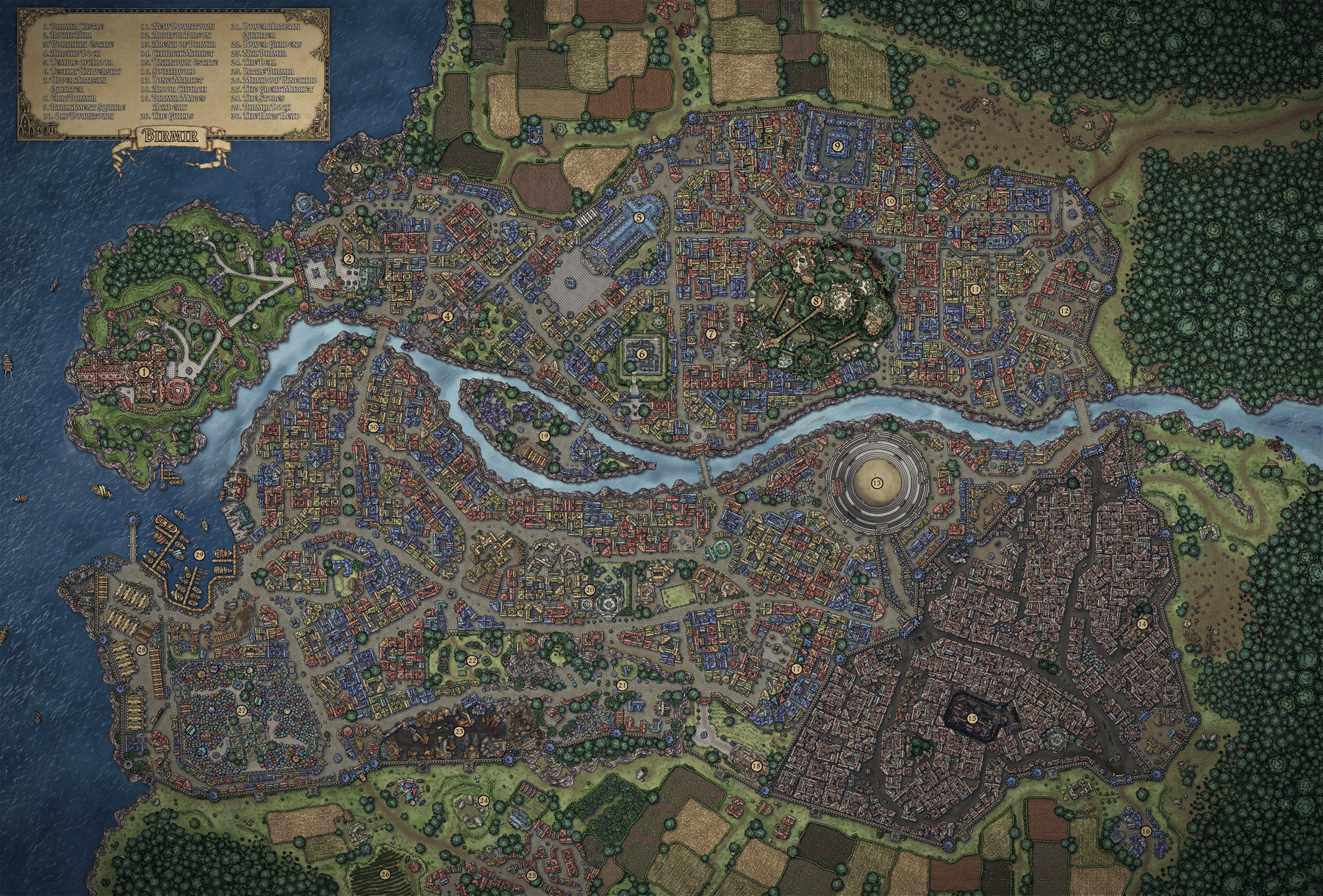
In the western reaches of the sprawling world of Ayria, Birmir stands as a city with a character as diverse as its riverbank setting. The town is divided by the flowing river, a natural boundary that paints a stark contrast between its northern and southern sections. In the upscale north, the air is tinged with an air of affluence, and the gentry reside in stately homes and apartments overlooking the river. Along cobblestone streets, opulent taverns boast real floors, and high-end shops subtly cater to patrons who don’t bother asking about the price. Here you will find those that rule Birmir, both regally, religiously and politically, often at heads. Centrally the High Elves have placed a sapling of their Home Tree, and expanded their district around it. These are the districts you’ll find those with well cut clothes, refined voices and manicured hands. Humans, High-Elves and the odd merchant Dwarf mix in the upper echelons of society here. Spanning the river are two bridges, both literal and metaphorical gateways. As one ventures southward, the atmosphere shifts dramatically. Here, taverns embrace the authenticity of sawdust-strewn floors, serving as gathering places for those with a penchant for grittier experiences. In the southern districts, hidden alleys reveal shops where haggling is an art form, and wares are traded in the shadows. The Great Market, located south of the docks, is a place where you can go to find almost anything that can be traded legally. A stones throw away you’ll find the Dwarven district, and specialist artisans quarter. There isn’t a race you won’t find passing through these streets - the bustling harbour will make sure of that. Merchants, Adventurers, Sell-Swords, Seers, Brewers, Tinkers, Cultists, Thieves, Bards. You name it, for years before you they’ve walked these streets. However, a pulse of Birmir beats strongest in the underbelly of its south side, where the notorious criminal organization known as ‘The Firm’ casts its long, dark shadow. With fingers deeply embedded in both legal and illicit affairs, The Firm controls the ebb and flow of The Slabs. As one navigates the labyrinthine streets, whispers of their influence weave through the air like tendrils of smoke. Birmir is a city where contrasts collide, creating a vibrant tapestry of intrigue and opportunity in the heart of Ayria.
—————
1. Birmir Castle
Birmir Castle rises from its own western peninsula, its stone walls hugging the rock tightly to ensure security. The towers are tall and elegant, and the inner buildings and main hall sit tightly enclosed. Along the roof line are filigreed ornaments and decorations, an outward demonstration of wealth for those that observe it. Within the outer wall sit the 4 Shuffled Houses - named this way as they regularly change hands between those who hold the most favour within the wider Royal Family at any given time. From its windows, the city is always visible but never fully within reach — a reminder that those who look out from here are separate from the general populace, for both sides.
2. Royal Hill
Royal Hill forms the built approach beyond the castle’s outer walls, a small district of orderly streets and gaudy structures pressed close together. Lesser nobility, officials, and wealthy merchants make up much of its population, and the area carries a disciplined stillness even at busier hours. It is close enough to the castle to feel its weight, yet distant enough that those who live here are always just outside the true seats of power.
3. Volarian Estate
The Volarian Estate stands apart through deliberate space and strong gates, its buildings arranged within space few in Birmir can afford. High walls enclose courtyards and private gardens, shielding the households from the surrounding bustle. Those who pass its gates know that wealth here is not merely inherited, but actively managed — counted, stored, and leveraged with care. It could be considered that those who truly rule the city can be found here.
4. Airship Dock
The Birmir Airship Dock rises above nearby rooftops, its long platforms and anchoring towers built to receive vessels that never touch water. Ropes, winches, and signal flags are ever present, and the air smells faintly of oil and treated canvas. Arrivals here tend to be deliberate and watched closely; few come by air without a reason, and fewer still wish that reason discussed openly.
5. Temple Of Aloor
The Temple Of Aloor stretches long and solemn among the northern districts, its stonework unbroken and formal. It is a place of processions rather than crowds, where lines form quietly and voices lower without being asked. Those who enter seeking judgement or binding oaths leave with matters settled — though not always in the way they hoped. A hospital for the destitute can be found along the northern side of the structure, well known for its ability to lose the odd patient now and then.
6. Teshla University
The original Teshla University sits enclosed and self-contained, its square walls guarding inner courtyards and study halls from the surrounding streets. In recent years, The University has expanded its campus to adjacent buildings within these streets, thanks to the help of successful alumni. Students and scholars move in steady patterns between buildings, often lost in thought or quiet debate. Knowledge here is accumulated patiently, and some lessons — particularly those kept in deeper archives — are not offered lightly.
7. Upper Artisan Quarter
The Upper Artisan Quarter hums from dawn until well past dusk, its compact streets lined with workshops and stacked residences. The clang of tools and the smell of worked materials are constant companions, and delivery carts navigate narrow routes with practised ease. Crafts produced here are sought after not only because they are flashy, but because they are reliable — and reliability in Birmir is a mark of mastery.
8. Elac’Bimir
Elac’Bimir (Birmir Tree) is the Elven district and contains a sapling directly from the elves Home Tree. The sapling is surrounded by carefully planned dwellings and quiet courtyards. The architecture is elegant and deliberate, favouring harmony over scale. Outsiders are welcome, but always aware they are being politely, thoroughly observed.
9. Parliament Square
Parliament Square opens wide at the heart of the northern city, its pale stone buildings and deep blue roofs framing the square in which the central parliament build resides. It is a place designed to be seen in, where speeches carry and gatherings draw notice whether welcome or not. Decisions made in the surrounding halls ripple outward from this space, long after the square itself has emptied.
10. Old Downtown
Old Downtown presses close to The Parliament Square, its buildings layered and irregular, shaped by generations rather than design. Narrow streets twist between stone walls, though obviously worn it is generally clean and tidy. Here a mixture of offices and businesses can be found that keep the city running. There are also some great bakeries.
11. New Downtown
New Downtown spreads east of the older core, its streets wider, its buildings more uniform and deliberate. This is where embassies, consulates, and newer administrative offices established themselves once Old Downtown began to strain under the city’s growth. The district feels polite and carefully neutral, a place where foreign banners hang beside one another and words spoken are chosen with care.
12. Arbitor Prison
Arbitor Prison is an angular complex embedded directly into the surrounding district rather than set apart from it. High stone walls enclose a series of internal yards and cell blocks, their presence unmistakable but deliberately unadorned. Prison traffic blends uncomfortably with everyday life here — carts pass its gates, voices carry over its walls — and while escape is difficult, it has never been considered impossible by those desperate or connected enough.
13. Arena Of Birmir
The Arena of Birmir dominates its quarter, a massive circular structure whose scale dwarfs nearby buildings. Crowds gather here from every district, drawn by combat, spectacle, and the promise of sanctioned violence. Though officially regulated, many bouts are said to settle debts or political grudges that could not be resolved anywhere else.
14. Church Market
The Church Market occupies the hollowed remains of an abandoned church, its broken roof and cracked stone repurposed into shadowed stalls and hidden chambers. Candles burn where altars once stood, illuminating goods that are rarely legal and never wholesome. Deals made here are quiet, personal, and often sealed with mutual silence rather than coin alone.
15. Unknown Estate
16. Southwold
Southwold lies along the southern approaches, a small cluster of homes erected in recent years. The settlers are mostly made up of followers of Kitoid, and were granted a land requisition from the Aloor Clergy to build a shrine and service the people of The Slabs with their demi-gods healing powers.
17. Long Market
Long Market stretches approximately 200 metres as a narrow, persistent artery of trade. It is where questionable goods filtered out of The Slabs first surface in semi-respectable hands, sold openly enough to appear legal. The market is always busy, always watched, and always pretending it does not know where its wares truly come from.
18. Aloor Church
The Church of Aloor in the south is smaller and more severe than its northern counterpart, built for worship rather than ceremony. Its walls are worn, its clergy practical, and its congregation largely local. Here, prayers are made for survival and forgiveness rather than balance, and the god is believed to listen just as closely.
19. Birmir Mages Academy
The Birmir Mages Academy occupies a the island inbetween the two halves of Birmir, its island set apart with decorative buildings and controlled access. Arcane study here is structured and regulated, with apprentices from both sides of the river deep in experimentation confined to approved halls. Strange lights and sounds are often seen after dark, while not all lessons are listed on the public rolls.
20. The Guilds
The Guilds occupy a broad, organised cluster of buildings, halls and lodgings, each representing a different vital function. Warriors, adventurers, merchants, artisans, and artists all maintain presences here, with lesser members housed in adjoining buildings. The district hums with quiet ambition — contracts negotiated, alliances formed, and reputations made or broken over shared tables.
21. Lower Artisan Quarter
The Lower Artisan Quarter sits elevated on a natural stone platform overlooking the southern districts below. The work produced here is practical and precise, often favoured by those who care more about longevity than ornament, and many southern traders quietly prefer commissioning goods from here rather than from the more fashionable northern counterparts.
22. Lower Gardens
The Lower Gardens occupy a contained stretch of land within the southern side of the city, laid out in simple, deliberate plots. Stone paths divide cultivated beds, trees, and open ground, offering a break from the surrounding density. Though modest, the gardens serve as a vital breathing space, used for games, quiet reflection, and the occasional discreet meeting away from crowded streets.
23. Nal Birmir
Nal Birmir is carved directly out of the southern stone, its entrances marked by heavy masonry and smoke-darkened facades. This is the dwarven quarter, where mine shafts descend beneath the city and forges burn day and night. A central temple anchors the district, its presence felt as much through vibration as sight, and the dwarves here consider their work the literal foundation upon which Birmir stands.
24. The Dell
The Dell rises as a strange hill of standing stones, their placement both natural and deeply unsettling. Long before Birmir grew into a city, its founders gathered here to debate decisions that would shape generations. Even now, voices tend to lower on this ground.
25. Little Birmir
Little Birmir lies beyond the city walls, a hamlet clustered on an outer road rather than the urban core. Its buildings are compact and irregular, built quickly and cleverly, reflecting the gnomish population that calls it home. Though technically outside Birmir proper, the settlement remains tightly connected to the city through trade and tinkering.
26. Mirabow Vineyard
Mirabow Vineyard spreads across open ground away from the densest districts. The vineyard’s buildings are modest but well kept, focused on production rather than display. Known throughout Birmir for its rosè, it has become a socially acceptable reason for northerners and southerners alike to gather without suspicion - often at one of its liberal tasting days.
27. The Great Market
The Great Market occupies a broad space near the southern docks, sprawling outward rather than upward. Stalls, tents, and permanent structures compete for space, creating a constant hum of movement and noise. While officially regulated, the sheer scale of the market ensures that not everything traded here is closely examined.
28. The Stores
The Stores form a cluster of large, utilitarian buildings positioned close to major trade route in and out of the dock. Their design is plain and deliberate, built to hold volume rather than attract attention. Control of these storehouses grants quiet influence, as shortages and delays here ripple outward into every district. Trespassers are known to be dealt with swiftly and ferociously.
29. Birmir Dock
Birmir Dock lines the entrance to the river with tightly packed piers, cranes, and stores, pressed hard against the southern edge of the city. Ships arrive constantly, bringing goods, labourers, and rumours. The dock never truly sleeps, and many who pass through Birmir only ever know this stretch of it.
30. The Hags Head
The Hags Head sits on a corner not far from the docks, its position convenient for those arriving with coin, stories, or nowhere else to go. The building itself is sturdy and well worn, clearly rebuilt more than once. Within its walls, adventurers trade rumours, form uneasy alliances, and begin stories that rarely stay contained to the tavern for long. Some of the most notorious adventures have started within these walls.